Wednesday, May 19, 2021

On the Road Again, Part 2a--Les Casses & Gorges du Tarn

The Viaduct of Millau, with the city itself off to the right.

This is the second part of our most recent travels in France, The first part, about our search for poppy fields, is here. The third and final part will be done soon!

Les Causses are a series of high-elevation plateaus about an hour and a half north and west of Montpellier. At one time a vast elevated plain, over the millennia rivers have cut deep channels, isolating the causses one from the other. The Tarn, one of the more significant rivers in the south of France, carved a gorge that is today a very picturesque tourist attraction. We made it the focus of our two-day trip.

The valley of La Dourbie, cutting through the causse.

The GPS routed us up the Autoroute A75, exiting just before the toll section, where we found a convenient turnout. I’m glad we stopped, because it was far more extensive than it looked, and gave us a good introduction to Millau and the start of the Gorges du Tarn. We got a good look at the causse and the gorge carved by La Dourbie, a tributary of the Tarn. We also had an overview of the city of Millau, and, in the distance, a stunning view of the Millau Viaduct, a spectacular bridge that carries the road (the A75) across the valley of the Tarn. 

I first heard of the Viaduct on a French television program some years ago. It seems that the city of Millau sits right on the main route between Paris and the Mediterranean coast, and every summer Millau would be inundated by travelers on their way to the beach for their annual vacation. Traffic backed up, and by the 80s it would take hours to get across the valley. A number of proposals were made to move traffic away from the city.

The outskirts of Millau and the incredible green countryside.

 
One concern of the townsfolk was that any bypass around Millau would result in a serious loss of business; the town would just dry up and blow away. The solution finally implemented was this bold and stunning bridge which broke several world records when it opened in 2004, and is still the highest roadway in Europe. It became a tourist attraction in its own right, and for those visiting the Viaduct, Millau is the obvious place to eat, drink, and spend the night.  

 And for us, too... but not yet! We had more exploring to do!


Le Relais de la Muse, a restaurant and auberge in the Gorge of the Tarn (closed, of course!)

Our route along the river led us around the city and through the surrounding hills along the narrow and winding river gorge. It was actually a very pleasant drive: the road was good, slow but not dangerous, and the hillsides, rocky cliffs, sights of the river emerging out of the lush springtime vegetation, and the occasional stone villages clinging to the river banks made for an engaging and ever-changing journey.

We saw this appealing church and churchyard from the road...
 
... and stopped to see it: Église Notre-Dame-des-Champs de Mostuéjouls.

The towns we passed through were pretty dead, with shuttered shops and cafés. But it was clear that this was a decidedly touristic area. In normal times… Actually, we were pleased that we had it almost all to ourselves, with few people and almost no cars!


The village of La Malène; looks like it was pretty lively, but dead when we came.


We made a stop on the river. It was hard to tear ourselves away, but we were on a road trip...

A ruined bridge once leading across the Tarn to Le Rozier--and a fabulous-looking resort on the river!

Still, lunch time came, as it always will, and all we found were shuttered shops and empty streets. But we persevered… maybe in the next town, maybe another 10 or 15 minutes… and then we arrived in Sainte-Enimie. Ah, people! Cars! Restaurants selling food to go on the main street!


We saw this village across the river--the sign says "Village en Peril." Which means just what it seems to: the village is in peril. The guy at the cheese shop explained that almost no one lives here anymore; with no road, the only way in and out is by canoe or zip line across the river!


At last--a town with people! Activity! Lunch!!

And what a charming place! Thirteenth-century buildings, and high up above the Tarn a former monastery, or maybe a tomb, where local legend has it that St. Enimie herself is buried.


Us, in St-Enimie

Paula and Kate exploring in St-Enimie

According to a 13th Century poem by a famous troubadour, Enimie was the daughter of a king who did not wish to marry. Her prayers to God were answered when she contracted leprosy (which certainly made her less attractive as a partner!). The search for a cure lead her to a spring, a tributary to the Tarn. The blue, copper-infused waters are said to have cured her; she settled down and founded a convent, where she spent the rest of her days.


This story was related to us by a cheese shop owner. We were drawn to his shop by the compelling sounds of the Grateful Dead’s “Casey Jones” (“Driving that train, high on cocaine…”); the owner spoke excellent English and chatted with us for a bit. As we were finally leaving, he asked if we’d like to buy some cheese. “Maybe later,” we said. Ah, “later” means “never,” he responded with a smile. True, very true. We resolved to get some of his excellent local sheep cheese later, before we left town, but alas, we, ah, never did. 

After lunch—take-away salads we ate while contemplating the cliffs across the river—we visited la source, the spring where Enimie bathed. Yup, it was blue! The adjacent information station was playing a video of underwater spelunkers exploring the cavern below the spring. We studied the accompanying diagrams of how the rain seeped through the adjacent causse and ran underground 12 km to emerge here and thence aboveground to the nearby Tarn.


The copper-infused blue water that cured St. Enimie of Leprosie.

It was getting late, and while we’d already decided to spend the night in Millau, that was an hour away, and we did have to finalize arrangements with our Airbnb host. Kate handled that chore while we crouched in an alleyway with 600-year old stone walls towering over us. Our accommodations handled, we were ready to get back on the road.


But first, we had a lengthy chat with a Brit who’d heard us speaking English. He said he was a truck driver, a forestier, a wood worker, and a chocolatier. He and his wife had a shop selling beautiful wooden cutting boards and chocolate; they’ve been here in Sainte-Enimie three years and love it. We had a pleasant conversation, and enjoyed hearing about the town (and the frequent floods!), but we felt the need to move on. After all, a 7PM curfew was still in effect all over France, and we were at least an hour down a long windy road to our home for the night.


Up Next:  We spent another day in the area, including some time under that fabulous viaduct. We'll here about that in the next installment. And that will have to come soon, because in a few days the cafés open, and we will be on the road once more, exploring... well, you'll have to wait and see!


AND---Cafés are now open! Finally! We're seeing tables on the sidewalks once again, with patrons sipping coffee and enjoying full meals. That changes everything!


Saturday, May 15, 2021

On the Road Again, Part 1—Poppies!


View out over the Luberon from Ménerbes


As the pandemic winds down, the confinement here in France is loosening up… but “loosening” is relative! No more 10km limitation on travel, and the curfew has been moved from 6PM to 7. Cafés and restaurants still closed, as are non-essential shops. We now have a schedule for opening: on the 19th of May eating establishments will finally open! Hooray!  Plus, the curfew will start at 9PM. Then, on the 9th of June indoor dining will be allowed, and the curfew will be set for 11PM. Certain theater and sporting events will open then as well.


We have been more than ready to get out of town, so the other day we rented a car for four days and set off, once more accompanied by our amiable travel companion Kate. Both Paula and Kate had a hankering to see the red poppies of Europe (in California we have the orange variety—it’s the State Flower, in fact—but not so many red ones). And Paula and I still carry the memory of the fields of red poppies we saw in Italy during our honeymoon trip in 1999.


Paula and Kate, out standing in the field.

Following reports of poppy sightings we headed north and east of Montpellier, towards the lavender fields we visited last spring (although it’s still a bit early for the lavender). As we were leaving a small town (seems like we’re always just leaving a small town when driving in the French countryside) we saw it in all its stunning red glory:  a large dense field of poppies! We did a quick U-turn and got off the highway.


We've got our stripes on in the poppy field!

We spent a good half-hour there, shutters snapping as we cavorted among the millions of paper-thin petals. Which was a good thing, because we didn’t see many poppy fields beyond that. (And the few we did find had no place to park!)


Kate, very happy to be immersed in poppies!


What's the point of a trip to a poppy field (or anywhere, really) without a good selfie?!


With or without a destination, driving in the French countryside is always rewarding. Although in this case we did have a destination: Saint-Rémy-de-Provence. The town is known for its hospital where Vincent van Gogh was treated in 1889, and where he painted some of his memorable works (including “The Starry Night,” which features the town). Some years earlier, in 1503, Michel de Nostredame was born here. He was later to be known as Nostradamus.


The nearly deserted--and rather sad--town square of Saint-Rémy

 But we were here neither for painters nor for prognosticators. Our goal was something more mundane: lunch. Paula and I had visited this town before and always found it lively and charming. This time, like most towns these days, it was neither. That cute, tree-shaded square with the 16th century arch where we’d eaten before? Not only was everything shuttered and closed, and the place empty of chairs and tables, but a truck was delivering sacks of cement to the whine of a concrete saw.


Paula and Kate in front of a typical building in Saint-Rérmy.

Another month and things could very well be hopping here, so the residents were getting essential work done while they could. (We see the same thing happening in Montpellier: still no customers allowed in the boarded-up cafés, but many of the squares they front are busy as the umbrellas and shade structures are prepared and repaired, in preparation for the openings on the 19th!)


This cute cheese shop...

...had this extraordinary window display. A French couple we spoke with here said this display impressed even the French.

We eventually found a pizza place doing take-out (the more enterprising restaurants and cafés have been offering take-out for several months; it’s allowed, so long as there is no place to sit!) We enjoyed our lunch while sitting on the steps of the nearly-empty parking lot across the street. While far from our idea of the “perfect French lunch,” it was, indeed, lunch, however imperfect. And, greatly appreciated.


We checked St-Rémy off the list, with a vow to come back later when it was more populated, and drove on.


An aerial view of the Village de Ménerbes.
----- Photo from Wikimedia by
Marc Gimpel (Own work)

Our next stop on our search for the perfect poppy field (admittedly a half-hearted search, since we’d already exceed our expectations with that first field) was the Village de Ménerbes. Built on a rocky ridge of the Luberon, Ménerbes is (yet another) Medieval village that benefits from the label granted by the association Les plus beaux villages de France.*


* Les plus beaux villages de France is a private organization that awards its designation to those small towns that have shown « Qualité, notoriété et développement »: quality, recognition, and development. In short, they’ve got something going on, they have a history and heritage they are proud of, and they want to show it off. These towns are always very pretty, interesting, and lively.


Art sculpture, overlooking the valley of the Luberon from the village of Ménerbes

A few lonely poppies, also overlooking the valley of the Luberon

Well, ok, these days no village is very lively. But Ménerbes is very pretty, and, having been built on a tall narrow ridge, has fantastic views out across the countryside. It’s another medieval stone village, yet like every village it has its unique character. After hiking around a bit and enjoying views from the many overlooks we found a café that served excellent coffee. To go, of course! Then, passing through the center of the village we came upon a shop selling local food items (quite common here; every place likes to emphasize their fine specialties). We picked up a prepared dish for dinner, headed back to the car, and were soon on the road home. That evening we had an excellent dinner from the eggplant (aubergine) dish we’d picked up in Ménerbes.


A quiet moment...

Typical view from an overlook 

The three of us ate together, which was, frankly, the first time Paula and I had shared a meal with anybody in months and months. But the three of us hang out together frequently, and we’d all had our shots (the second one a week earlier), so it was low risk. It was also very, very liberating!


Entrance to the town cemetery.

A parting view of Ménerbes.

We’d rented the car for four days, but we took the next day off, saving ourselves for the weekend. We’d planned an overnighter, another post-pandemic first!


Up Next:  We still have two more days to report on, including our trip up the Gorges of the Tarn River, and the amazing Viaduct of Millau.


Sunday, April 11, 2021

Our Ride to Roussillon

The iconic  Abbaye Notre-Dame de Sénanque in full summer glory.
.... photo from www.senanque.fr


Le printemps est inexorable.

I’ve been seeing banners around town with this quote from Pablo Neruda. The spring is inexorable, unstoppable. And it’s true. Spring is coming, relentlessly. Every day we see more leaves, more greenery on the trees and bushes around here. It makes me realize what is meant when I hear California has no seasons. There are trees back home that lose their leaves on the winter, but not so many, it seems! 

From my window here in Montpellier I can see evergreens–pines, mostly–and many bare branches. But the un-leaved are becoming rare; most of the recently-bare branches are now sporting thin leaves of a light green. The trees behind our balcony, providing a wall of green during the summer, are still in process: the streets and red tile roofs of the adjacent neighborhood are clearly visible. But any day now those leaves will unfurl, and the sight of the neighbors will become a memory. The birds are already busy choosing their locations among the still-bare branches; they know what’s coming!


The still-bare branches and our neighbors beyond our balcony.


 Back before we started all this travel stuff, when we were working and were mere travel wannabes, we rented the spare room in our house in California on Airbnb. We met a lot of wonderful people, and heard great travel stories. And we would regularly help foreign visitors sort out their travel plans. Often we were horrified by the overly-ambitious plans of our guests. They wanted to go to Yosemite National Park, see the Grand Canyon, visit Death Valley—and the Mojave—check out the redwoods, then end with a few days in San Francisco. And maybe, visit a few wineries. 

Well, we’d tell them, you’ll be spending all your time driving. That’s a lot further than you think! 

We recently had similar experience ourselves. 

I had just received my newly-earned French driving license when Wednesday evening French President Emmanuel Macron laid out the plan for yet another lock-down, to begin Saturday, the day before Easter. So Friday we took off in a rental car on a day trip, with our friend, fellow expat, and charming travel companion Kate. We planned a tight loop that would take in about seven promising locations and, according to my generous time table, get us back home by 4:30. Hah! 

We made it to four of the seven and got back home by 6:30, beating the curfew by a bare half hour! Saw some great stuff, though.


Tip of the island where the Sorgue splits.

Isle-sur-la-Sorgue

Nominally an hour away from Montpellier, it took us almost two to get to this small town, thanks to the many slow traffic lights around Avignon. But when we arrived, we were utterly charmed! It was surprisingly crowded (we’ve grown used to finding towns empty), perhaps because others, like us, were out for a final excursion before the confinement. 

Paula and Kate contemplate a main shopping street...

... and this cute cafe (closed, 0f course!)

As the name suggests, the town started out on an island on the Sorgue River. While the town has far outgrown the tiny island, the watercourse provides an undeniable charm.


This pair of ducks took time out from their river swim to join us for lunch... or at least hang out, hoping for a hand out!

We bought sandwiches from a take-out vendor; there were convenient-looking tables just outside. I asked if we could sit there. He cited the law closing cafés all over France: "135 Euro fine!". OK, maybe not such a good idea after all. So I showed him this photo. He agreed, yup, that's the way it is...

Sign in front of a café in pandemic France: "Coffee to go -1.50€...Coffee here - 135€"    


 Abbaye Notre-Dame de Sénanque

Anybody who has spent even a few minutes researching the lavender fields of southern France has run into the photo at the head of this blog. This iconic monastery, the Abbaye Notre-Dame de Sénanque, is—quite literally—the poster child for lavender fields.

Our first view of the abbey from a road overlook.
 Of course, when we were there it didn’t look like that! The lavender peaks in the summer, and was just getting started this early in the year. Plus, the abbey, undergoing a major restoration, was covered in scaffolding. (Not the first time we’ve run into this; when we were in London a couple of years ago Big Ben, the iconic clock tower of the Parliament buildings, was all but invisible behind scaffolding; and probably still is!). 

What the abbey looked like the day we visited (compare to the photo at the top!)

But the abbey, set in its narrow, wooded valley in an isolated rural setting, is a fabulous place to visit. The setting was chosen by the Cistercians in the 13th Century; their charter required their monasteries to be located away from towns and villages, and to be self-sufficient. The river Sénancole (the abbey’s name derives from the Latin sana aqua, pure water, a reference to the river) was somewhat stronger back then, and provided irrigation and fertile soil. 

The abbey prospered for a century or so; then the discord and violence of the 15th century drove it into decline. During the Revolution of the 1790s it was sold for income (as were many other religious properties). Sold again in the mid-1800s, it once more became the seat of a religious order. After some ups and downs, the abbey returned to the Cistercians in 1988. Since then the monks have made a living cultivating lavender, as well as olives and honey, and by offering hospitality to visitors. With this income they are slowly restoring the monument. (Info from the abbey website, https://www.senanque.fr.).


View of the abbey from the back with hikers passing by.

We wandered around, contemplating the buildings from several directions and enjoying the outdoors. There appears to be extensive hiking trails behind the abbey, through the narrow valley of the Séancole. I saw a group of hikers emerge and would have liked to spend some time exploring, but we had a different trip in mind. 


Paula's excellent photo of the town of Gordes spilling down the hill.

Gordes

This village is the closest habitation to the Abbey of Sénanque. It’s dramatically located, spilling down the side of the hill. Sadly, we missed the viewpoint heading into the town, but Paula was quick enough to catch a snapshot.


The main square of Gordes; looks like we're back to deserted towns!


Folks just hangin' around on a slow afternoon.

Gordes has livened up the cold stone walls with large surreal B&W images.

The town itself was mostly deserted. We’d come to expect this by now, with government action against the pandemic keeping most shops (and all cafes and restaurants) closed. Still, after our visit to the very lively Isle-sur-la-Sorgue we were prepared to see more activity. It did occur to me though that this was the afternoon of Good Friday, and while France is expressly a secular country, it does have strong Catholic roots. And in predominantly Christian societies Good Friday afternoon (traditionally considered the time when Jesus was crucified and died) people tend to stay in.

Plus, all the cafés and restaurants were closed!        

Kate heads down to the overlook.

We interrupt our sightseeing at the overlook to smile for Kate's camera.

We wandered the quiet streets a bit, found a coffee take-away place, and admired the view of the surrounding countryside before heading to our next, and last, stop.


Buildings in the town of Roussillon, with their distinctive red-yellow tones.

Roussillon

Paula and I visited this town a couple of decades ago, and I still recall the Sentier de Ocres, the Ochre Trail, winding past cliffs of yellow-brown earth.  Once upon a time, a century or more ago, this powerfully-colored earth was a valuable resource. The pigments mined from the earth here were in high demand for use in dying textiles and coloring paints. But production waned, and by the 1950s chemical dyes had replaced the natural ones.  

A mostly-deserted square in Roussillon.

Classic shot of the Roussillon clock tower.

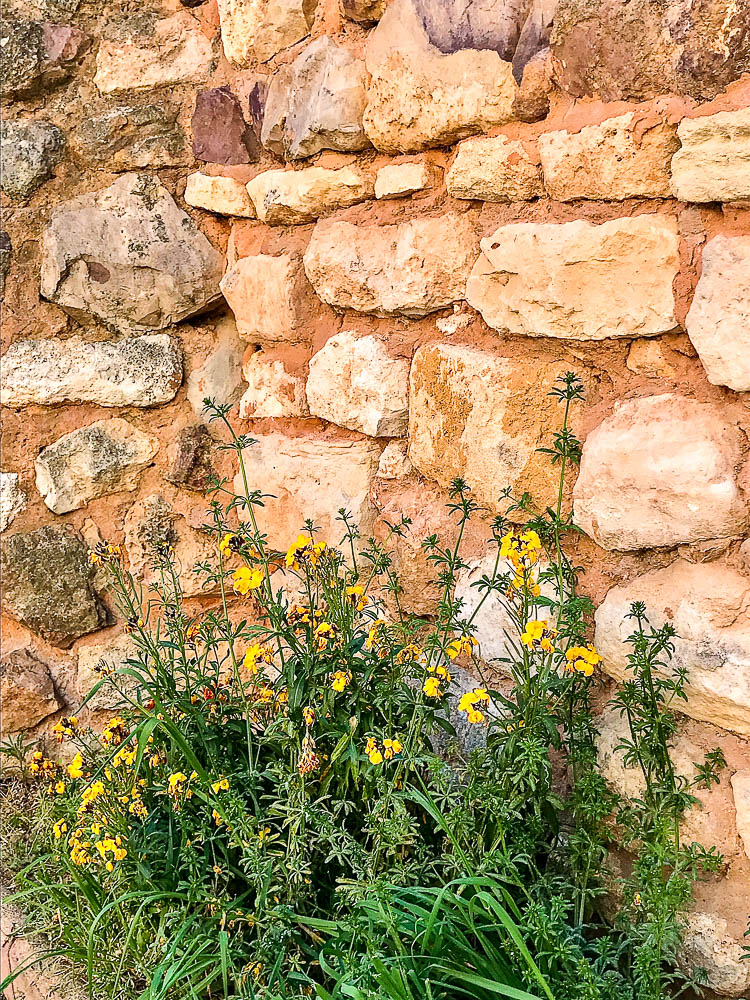
Wildflowers along a wall (thanks for the photo, Kate!)

What’s left, though, is a beautiful, colorful village, accepted as one of Les Plus Beaux Villages de France®, an official designation recognizing it as one of the Most Beautiful Villages in France. (Gordes, which we’d just left, has the same designation.)


Roussillon side street.

A close look at this doorway shows the date 1698 inscribed in the lintel.


Again, the village was deserted when we arrived, so we had the place to ourselves as we wandered among the homes and buildings displaying the astonishing variations of the yellow-orange-red ocher found in the area. 

One thing we did not do was walk the Sentier de Ocres, that path through the former ocher mines just outside the village. Time, like the spring, was moving inexorably, and we had to be getting back on the road. It was a long drive back, and we had to think of the stamina of the driver (me!).


What looks to be an old lavender still (to extract the essential oils), now an objet d'art.

Gotta love those warm red tones!

View of the ocher buildings or Roussillon; the top peaks of the Sentier de Ocres is just visible on the far left center.

We definitely must return to Roussillon. On this, my second visit, I remembered absolutely nothing from our first visit, except for wandering the paths through the amazing ocher hills (the part we missed this time!) . I really want to walk those colorful canyons again!

Paula and Kate work their careful way back down to the parking lot. We will definitely be back!

 10 March 2021