|
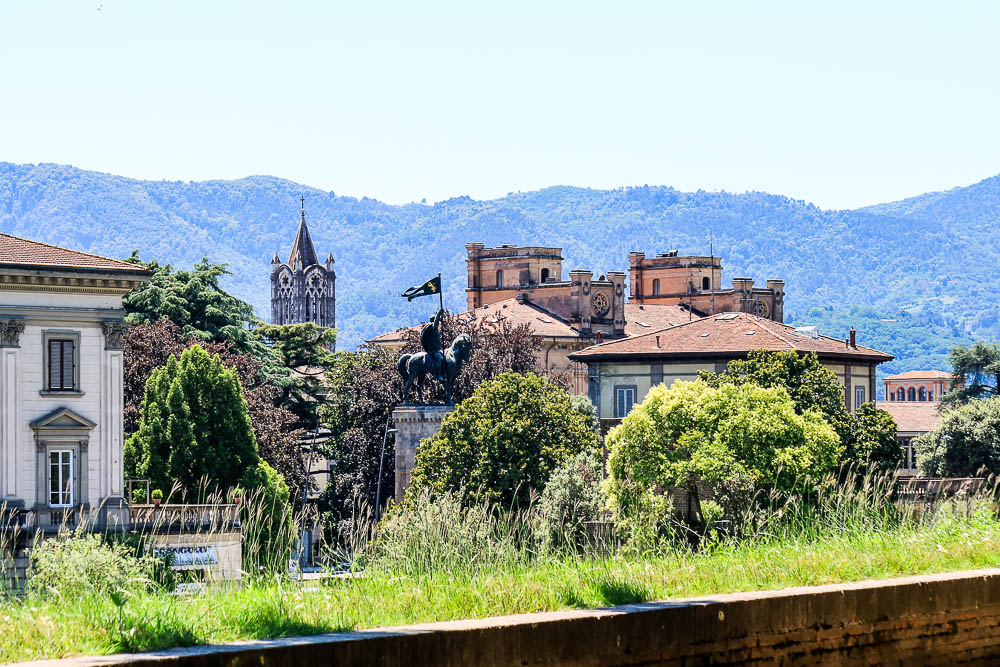
| Lucca's Chiesa dei Santi Giovanni e Reparata, the Church of Saint John and Reparata. |
In our last blog (you can find it here) we left Corsica, after a week of beach-going and exploration, on the ferry to Livorno in Italy.
Lucca
Paula had planned this trip very cleverly. She realized that once on Corsica we were very close to Italy. And, since we were almost there, why not continue? It was a short hop from Bastia on Corsica to Livorno in Italy. So we got the car to Italy mostly by ferry, with very little driving!
 |
The somewhat famous Torre Guinigi.
There are lots of towers in Italian towns; in centuries past, it was a sign of great wealth. |
Under our original plan the ferry would arrive in Livorno in the afternoon, too late to do much else. So, we'd spend the night, then move on to Ravenna in the morning. But the revised schedule left us in Livorno around noon with no particular reason to hang around: the city seemed seemed industrial, a port town; not very interesting.
 |
| The justifiably famous Duomo di San Martino (remember, in Italia duomo means cathedral, not dome!) |
 |
| Close up of the also famous, finely-carved façade of the cathedral. |
Lucca, though; now that was a town worth (re-)visiting! Initially we hadn't planned to stop there. Debra, who had her own plans for Italy, had already booked a couple of nights in Lucca, but with the extra time we had after the schedule change, we figured we'd spend a night there, too.
 |
| Entrance to the duomo. The stripped effect of the dark and light marble is strongly reminiscent of the church we saw on Corsica, the Èglise Saint-Michel de Murato (which, in fact, was built by craftsmen from Pisa, just down the road from Lucca). |
This was our, er, third trip to Lucca, and we knew there would be no problem filling an afternoon and evening wandering through the narrow streets among the architecturally-striking churches and public buildings.
 |
| The Torre Guinigi, nighttime version. |
We emerged from a wonderful dinner at a small restaurant into a light rain, which ended up not impeding our evening stroll in the least.
 |
| Love these doorways in Lucca! |
After our nighttime passeggiata we returned to our rooms at the converted monastery (chosen because they offered a place to park the car!). The next morning we had a very satisfying breakfast, loaded the car, bade farewell to Debra, and set course for Ravenna.
 |
| Seen in the streets of Lucca, the family name on a flooring van: a reminder that our grandfather came from this area, where the name Menconi is common, over 100 years ago. |
On our several previous trips to Italy we'd found the turnpikes (like freeways, but with tolls) a bit claustrophobic.
Oh, the roads are great, smooth and wide and well-designed for high-speed travel. But there's no shoulders! (Every kilometer or so there is a wide spot for emergency stops.) Unlike France and Spain, both sides of the Italian roadway are crowded by guardrails, And, in places where trucks are likely (often!), the guardrails extend to above the roof of our car! It feels very hemmed in, unlike France where a generous shoulder opens to green fields and trees.
We left Tuscany, with its soft hills and valleys, olives, grapevines, and centuries-old cypresses, and entered Emilia-Romagna and the Po Valley. Here the land is flat and low, with gently wooded slopes; excellent farmland, and home to some of Italy's most famous foods: ham from Parma, excellent aged vinegar from Modena, and, er, what is Bologna known for?
Ravenna
I was not overly impressed by Ravenna, as a city. The big attractions, certainly compelling, are the 6th-century churches with byzantine mosaics. Oh, and Dante's tomb. Dante Alighieri, author of the Divine Comedy and other notable works, spent his last years in Ravenna.
 |
| Ravenna: The Basilica di San Vitale, built in the 6th century. |
 |
| Inside the basilica. An amazing interior! |
 |
| Interior of the Basilica, from another perspective. |
 |
| Very fine 6th-century mosaics inside the Basilica. |
Ah, Dante. Very popular in Ravenna! This decade was the 700th anniversary of his death (14 September 1321, in Ravenna), and his image was all over the city.
 |
A small portrait of Dante seen on the wall of a public building, taken from a posthumous painting by Sandro Botticelli from 1495; in mosaic, of course!
(Thanks to the extensive and extraordinary Byzantine mosaics, Ravenna has become a center for mosaic schools and artists.) |
 |
| Dante's tomb, built in 1781. There was some controversy over his place of rest: he was born in Florence, so that city wanted his remains, but Ravenna kept the bones and eventually built him this tomb. |
 |
For his 700th birthday a local museum, the Biblioteca Casa di Oriani, hosted a collection of modern interpretations of Dante.
(Hey, don't ask me, I just took the photos!) |
Ah, but we're not done with the mosaics! These are from the Mausoleum of Galla Placidia (5th C.)
Apparently it was built for an empress, although details have been lost. The mosaics themselves have been well preserved, and are full of Christian symbology.
 |
| No, we're not burning books, this is Saint Lawrence who was martyred by fire; the cabinet on the other side of the flaming gridiron contains the Gospels, symbols of faith. The window is of translucent alabaster. |
 |
| The ceiling of the vault, a starry firmament. Saints Peter and Paul frame the alabaster window. |
Bologna
We spent only a single night in Bologna. (And, no, baloney does not come from this city, although the region does produce quite a number of sausage-like prepared meat products. Oh, and tagliatelle; let's not forget the tagliatelle!) One of Bologna's claims to fame is the world's oldest university, established in 1088. (That beats out Montpellier's oldest medical school, which only got started in 1220.)
 |
| A sun-lit portico on the Via Santo Stefano. |
The other big attraction, perhaps more significant for us visitors, is the porticos. There are literally miles of these arcades in the city, some with very decorative tile work. Need to pop over to a shop in the pouring rain? No problem, you can plot out a course that stays mostly under cover the whole way! (On this visit, though, I found a downside: noise. Traffic noise is enhanced in those porticos!)
 |
| Further along the Via Santo Stefano, buildings with porticos. |
On this trip we only had one night in town, so our time was short. We were entranced by tightrope walkers high over the city. Apparently a week-long conference was just ending, and the aerial display was part of the closing ceremony.
 |
| An aerialist above the Piazza Maggiore; his tightrope is anchored to the Torre dell'Orologio (the clock tower, but it sounds better in Italian). |
 |
It seems Italy as a whole, and Bologna in particular, has become a mecca for "food tourism."
A recent article in the NYTimes referred to scenes like this—pasta making in a restaurant window—as "zoo-like simulations of Italian grandmothers." (And here I thought it was charming...) |
 |
| Nighttime view of Basilica Santuario Santo Stefano (also, conveniently enough, on Via Santo Stefano). |
 |
| A spiral fluted column in yet another portico. |
Padua
This was not our first time in Padua, quite. Some years ago we parked the car here so we could take the train into Venice (parking is much cheaper here than on the outskirts of "La Serenissima").
On that first trip we visited the Scrovegni Chapel with Giotto's magnificent fresco cycle, but saw nothing of the city itself.
Since this was our fourth Italian city in a week, comparisons were inevitable. Architecture. Arches. Carved stone doorways. Churches. Frescos. And art. An accumulation of art spanning 2000 years or more (although, admittedly, the older stuff is rare.)
And it's easy to say it begins to run together... because it does! Padua has porticos, it has arches. And it has frescos...
 |
| One night, walking back to our lodgings, we came upon an open doorway that lead to a cloister with some pretty nice frescos... |
 |
| They were a bit hard to see, being faded with age; plus, it was dark! |
 |
| But it was a thrill to find them! |
 |
| Palazzo della Ragione |
The Palazzo della Ragione is a remarkable building. Finished in 1219, it is the largest medieval hall still in existence. Today the lower level houses shops and market stalls, much as it did in the 13th century. The upper floors were the town hall and the palace of justice. Today, however, the upper level is a huge museum, 80x27 meters (260x89 feet).
 |
| The portico surrounding the upper levels of the Palazzo della Ragione. |
The walls are decorated with frescoes depicting the trades of working people, ordinary life, and character traits, all related to signs of the zodiac. Originally created and painted by Giotto, a fire in 1420 required them to be re-done.
 |
Inside the Palazzo della Ragione showing some of the 500 frescos that decorate the interior.
The "overturned boat" roof is 27 m (89 ft) high. |
 |
| Another view of the frescos. |
 |
| Detail of one of the frescos. |
We spent an extended time in this room, sitting and contemplating its enormity. We also moved about examining the walls, working to identify the images and how they related to the associated zodiac sign. Or, for that matter, identifying the zodiac sign! (In that, at least, we were somewhat successful.)
 |
| Also on display at the Palazzo della Ragione was this massive wooden horse (no, not from Troy), apparently made in 1466. |
It was a stunning experience! I'm very glad Paula wanted to go in; from the outside there is no hint what the interior walls hold. And it's not the kind of thing we are normally drawn to. But, totally worth while!
 |
| The Piazza delle Fruti market place, just adjacent to the Palazzo della Ragione . For 800 years farmers and vendors have been coming to this square and setting up their stalls. That's impressive! |
And now, finally, one of the top sights of Padua, the Basilica di Sant'Antonio da Padova. The spires rise over the surrounding buildings, and we saw them every time we left our lodgings, but did not actually get to the building for several days. It's impressive, particularly at night.
 |
| The Basilica of Saint Anthony of Padua, the second-largest church in Padua, finished in 1310. |
 |
| The main altar of the basilica. There are numerous chapels inside, as well. |
 |
| We first saw the basilica at night. It's quite imposing! |
Three nights, that's all we had in Padua, then it was time to move on. We were up early in the morning and on the road headed west, all the way to Ventimiglia, on the border with France. That last third was nasty: a twisty road through the coastal mountains, moving from bridge to tunnel, tunnel to bridge, and then, oh, another tunnel!
 |
On our way home after our last night in Padua I was just a touch hungry.
We popped into this snack bar and had a wonderful tomato and mozzarella panini... |
We were glad to finally arrive in Ventimiglia and plunk down in our rental for the night (a very nice place on the side of a hill overlooking the Sea). After resting, we went into town to meet with our friend, Debra, who was rejoining us for the next leg.
In the morning we were up early again, and on the road (again!) for the 2-1/2 hr drive to Aix-en-Provence and the special exhibition on the painter Paul Cezanne.
But that's all for now. We'll talk abut Aix in our next blog...
 |
| Basilica di Sant'Antonio da Padova. Impressive at night! |