Friday, August 7, 2020

How We Spent Our Summer in France, Part 1

 Oh my, but it’s been hot! Like really hot. Like 35°C/95°F hot. And, 65% humidity! Dry heat I can take, but humidity? No thanks! Still, the locals keep telling us: uh no, it’s not hot yet! Wait for the canicule! That’s like a heat wave, or something. Last year in Montpellier the temperature reached 45°/113°. We’re not in any hurry to get there! 

How can we get to Iceland??

We’ve also looked at getting out of town. In fact, we were planning a week in Brittany, France’s northwest Atlantic coast. But, the COVID numbers in that area spiked. It’s not a heavily populated area, and we wouldn’t be hanging out in the big cities (Brest, Quimpier). But this is vacation time, and Paula could not find accommodations at any place for more than two nights at a time. Well, that’s ok for a week, two nights here and one there… Except, this is the time of COVID! Every new lodging is a new opportunity to pick something up. Staying one place for a week? OK. Four places in one week? I think not! When we went to Lucca and Florence (link to that trip here) we knew no one had stayed in those rooms for at least several nights. So, we’ll save Brittany for another time, and continue to enjoy Montpellier. 

So what have we been doing, besides hanging out in our air-conditioned flat? We’ve had a couple of outings…


Views in front of Noilly Prat, in the small town of Marseillan


            Noilly Prat

One of the joys of living in France is visiting its many wineries. And, about an hour’s drive from Montpellier, is the producer of France’s premier vermouth, Noilly Prat. One day while we were playing boules someone in the group suggested we take a tour of the facility. So we did! 


Obligatory no-longer-used polished copper steam-punk distillation vessel on display at the entrance to the winery. Sign reads ""Behind this door is produced the premier French vermouth". 

The sales area. While not visible in the photo, the artisan who did the steel work welded his personal petanque ball to the top of the flag staff! (You don't find that kind of dedication everywhere...)

Vermouth is a bit of a mystery to me. It’s a fortified, flavored wine that’s never been very popular in the US. Aside from its use in martinis, I haven’t heard much about it. In Europe, on the other hand, it is often drunk as an aperitif, particularly in France and Italy. 

First stop on the tour: the blending barrels.


Vermouth starts out with a light white win
e. At Noilly Prat they use wine from nearby vineyards, aged and blended according to the original recipe Joseph Noilly developed in the mid-1800s. The wine is blended, fortified with alcohol to 18%, and then aged for a year in barrels kept in an outside yard. This aging exposes the wine to hot sun, cool winters, and constant ocean breezes, mimicking the long sea voyage that most wines of the 18th and 19th centuries had to endure (and is the reason that this spot, close to the sea, was chosen by Noilly Prat). 

The outdoor aging yard, exposed to sun and wind.

These barrels are used here for up to 12 years;
they tend to get a bit beat up!

I was particularly fascinated by the story of the barrels. Noilly Prat gets them principally from the sherry producers in the south of Spain—after having aged the sherry, the barrels contribute to the complex notes of the vermouth. In turn, the sherry producers get the barrels from distillers in the US, where they have already done duty aging whisky. Prior to that, the barrels were white oak trees growing in France. (So, there is a busy international trade in oak!) 


Back on the south coast of France, after the fortified wine is aged for a year it goes back inside to other oak barrels, where a select blend of herbs, spices, roots, and bark are added. And, of course, the botanicals added to the wine are carefully selected to produce the desired flavor, balancing tartness, acidity, bitterness, and so on. Noilly Prat produces four or five different products, each with its unique blend of essences. 


More steam-punk machines, now no doubt replaced by a sleek and efficient stainless steel box

Meeting place for the Coven? Or VIP tasting area?

Our guide was careful to tell us that each morning, when the work crew arrives, they start their day by spending two minutes at each barrel, hand stirring the botanical mixture into the wine (the only vermouth producer that still hand stirs!). After steeping for three weeks, the wine is decanted and stored for eventual bottling, which is done at another facility up the coast. 

After the tour came the tasting room, where we were served cocktails made with our choice of Noilly Prat vermouth and the appropriate citrus zest (orange, grapefruit, lemon, lime, depending on which of the vermouths we’d chosen). It is, indeed, a light a refreshing drink, although much less favored now than a half-century ago. 

  •  Tasting time! And yes, the overhead structure is made of old barrel hoops.

A fine Noilly Prat cocktail with a twist of lemon, served by our guide/bartender.

Next came the expected opportunity to buy bottles of the product—and the clever molds for the spherical ice, err, cubes(?) used in our cocktails. Then, finally, it was on to lunch, always a worthwhile experience in France. 

After about an hour and a half, as lunch was winding down, it was suggested we head over to Bezier, a near-by city, to check out the famous seven-step “staircase” lock. This extraordinary series of locks, part of the original Canal du Midi built in the mid-1600s, allows the canal to rise/fall 21.5 vertical meters (70.5 feet). It’s quite an engineering feat for the 17th Century, and is still in use today. 

The Bezier cathedral, a few kilometres distant.

The top of the "staircase," ready for the long ride down...


While Paula and I had been there just the year before, shortly after our own week on the Canal du Midi, we went with the group (not that we had much choice; it was the driver who suggested we go!) The sun was hot, but the process of locking boats up through the subsequent stages was fascinating enough that we stayed with it for the hour or so it took to get the boats all the way to the top. 

...and looking up from the bottom.
 

            Séte

Séte is a pleasant small town on the water, built at the base of a huge mound of a hill, Mont St Clair. It was once an island, anchoring a long sandy spit stretching several kilometers to  the southwest. It’s now attached to the mainland by a few bridges, with easy access from Montpellier—in addition to the highway, there are trains throughout the day that make the 15-minute trip. 

Aerial view of Séte and Mont St. Clair. Photo courtesy of the tourist office.

The town was built in 1666 specifically as a port for the newly-finished Canal du Midi, giving access to the Mediterranean. The port is now all grown up, and is a major shipping point for the South of France. The city has also become a major tourist attraction, thanks in a large part to the 10km (6mi) of sandy beaches along its sand spit. The sand spit protects the Etang du Thau (an étang is a small body of water, a pond or, in this case, a salt water lagoon) from the Mediterranean Sea. The calm waters of the étang support the commercial growth of oysters and mussels, an important regional product. (And just across the étang, 12 km distant, is the small town of Marseillan, home of the Noilly Prat winery!) 

View along one of the canals of Séte with Mont St Clair behind.

On the day we went to Séte it was hot and crowded (but decidedly not flat!). I have to say our experience was mixed. We headed for a delightful square a few blocks up from the water, expecting to spend a peaceful 20 minutes relaxing and enjoying some coffee. But the square was packed, and we ended sitting near the road, with the already annoying traffic noises punctuated every few minutes by a very noisy motor scooter climbing up the steep street. 

A shady square in town, but all the cafes are crowded at the far end! The van on the left is recruiting for Le Légion étrangère, the French Foreign Legion. Maybe that's why the square is so empty...

We continued on our way—on a pedestrian-only street!—and found a very fine indoor market. (Indoor, so air conditioned!) It looked like a great place to have lunch, but as it was still early we moved on. 

Another view of a different canal, running along the main street.

Back out on the main street fronting the canal we waited for the once-an-hour bus that would take us up and over Mont Saint-Clair to the beaches on the other side of town. We wound up steep streets past stone walls and steel gates enclosing what we imagined were fine villas with expansive views out over the town towards the sea. (The walls were high enough, and the gates sufficiently solid, that what lay beyond remained a mystery. But I’m sure there were some fine properties and spectacular views!) 

Panorama from the peak. On the left is the Etang du Thau, with the Med on the far right, and Séte's main canal down the middle. Montpellier is in the very distant center.

The bus arrived at the top with its expansive lookout, but I was not ready to leave the comfort of my seat, so we rode the bus down to the other side of the hill, past more iron-gated stone walls. Since we weren’t really interested in the beach, we just stayed on the bus as it climbed back up the same road, making the same stops, to the top. Now we were ready to get out, so we had a chance to take in the magnificent panoramas of the extensive étang and the distant hills on the mainland. 

Another view from the top: the Etang de Thau, with it's commercial oyster racks visible towards the left. That curving peninsula looks like a great place to have a house!

Next came the long, long walk down, all 183 vertical meters (600 ft.) of it! (My calves hurt for three days after that.) Still, better going down than up, and once back in the town we rewarded ourselves with lunch at the indoor (did I mention it was air conditioned?) market, accompanied by a couple of tall, cold beers. 

Looking back, I'm glad we're headed down, and not up!

Half way down! It gets a little less steep.

The Paul Valéry High School, named for a well-known French poet born in Séte.


A colorful street near the high school


It was a good outing, but we are looking forward to returning next month in September, when the tourist season is over and the weather a bit cooler.


Séte has some pretty outrageous street art!!


What’s next?

Our Paris trip is on hold. It’s just hot everywhere! We are thinking of renting a car for a few days and exploring locally. There’s a couple of rivers in the area, with quiet coves and shady beaches. Check back in the next blog to see what we end up doing!


Saturday, July 25, 2020

Lavender Fields Forever

One of the local trips around Montpellier we’d been planning was a visit to the lavender fields in Provence, a couple of hours north and east of where we live.  However, our return from Italy had us passing right by that area, so we thought we'd stop there for the night  and cut a couple of hours off the day’s drive. 

As usual, Paula surveyed potential lodgings in the area before we left (via the Internet, of course). Seems that the small towns, with their promise of seclusion and endless cuteness, were both very expensive, or not available (or both!) Same with the town of Valensole, which is definitely Lavender Central. What to do?

The town square in Manosque.
 

As we studied the map, Google pointed out that the fastest route to Valensole looped west towards Montpellier before turning back east to Valensole. The shortest, most direct route was along the back roads. France’s départemental routes can be a real joy to drive, winding through the countryside at a relaxed pace. But we figured that after five hours through tunnels and work zones we’d be anxious just to get there. So we’d skip the meandering and take Google’s suggested fast route, which lead through the town of Manosque.  As a place to spend the night Manozque seemed like second best, but lodging was plentiful and the hotels were inexpensive.


Church in the Manosque town square, with an interesting pentagram pebble mosaic.


Our room in Manosque, and Van Gogh's in Arles; that could be the same chair! (almost). After all, Arles is only about an hour and a half from Manosque.

Our initial disappointment gave way to delight once we’d checked in. We had a cute, very pleasant hotel in the middle of the (quite small) old town, with a good selection of restaurants within walking distance. We had an excellent meal, cooked and served by a woman who was very pleased to have us as customers. (Significant difference between American and French restaurants: in France, the main focus is on serving the customer by providing an excellent dining experience, and making some money. In America, the priorities are reversed.)


Sunflowers! We saw sunflowers, too!

The next morning we headed out, the GPS programmed with lavender fields recommended on several websites we’d researched earlier. While there was a bit of confusion at first (we had to readjust our thinking: this was no longer the "return from Italy trip"; now it was the lavender field trip!), soon enough we were in the thick of it. Sunflowers, endless fields of lavender, distant mountain peaks (the Alps?), and—surprise—pink lavender! (I think…). Well, just look at the photos!


A seemingly endless field of sunflowers...

...next to an endless field of lavender!

One of Paula's photos; she was quite taken by the sunflowers! (And they seem so attentive to her.)


Paula photographed the flowers; I liked the bees!


Along with the lavender lavender, we also found this pink lavender.

Mixing the two colors made some beautiful combinations.

The distant mountains set off the fields.

Sunflowers can really make you feel like the center of attention!

The fields aren't endless, they only seem that way.

We did eventually make it to the town of Valensole. It was, perhaps, marginally cuter than Manosque, much steeper, and certainly more crowded (Manosque definitely had a better choice of restaurants!). We stopped there for a late lunch, and slowly wound our way back home to Montpellier.


Arriving at the center of town in Valensole after climbing down a long, narrow, steep street.

Like all over Provence, plane trees keep the town center cool and shady.


And so ends our trip to Italy. We are planning a visit to la Bretagne, Brittany, in a few weeks. Stay tuned!

And, whoops, rising COVID numbers in Brittany means we put the kibosh on that idea; instead next week we'll take advantage of the dearth of tourists and take the train to Paris...


Tuesday, July 14, 2020

Andiamo in Italia - Seconda Parte

Lucca


This is the second part of our trip to Italy. See the first part here.


First off, why did we go to Lucca? History! Short term: three years ago we came to explore Lucca and the surrounding area. Longer term: about 120 years ago my grandparents were born near there! Which, after all, is why we went there in the first place… This time we wanted to recreate our trip of three years ago (see that blog here), except spend more time in Florence, a train ride away. 


Our arrival in Lucca was preceded by a drive along coastal mountains that, at first, appeared to be sprinkled with snow. This got Paula’s attention, but she quickly realized that it wasn’t snow, it was stone. We were passing through Carrara, site of the marble mountains that have been providing the raw material for statues since before the Romans. And still are today!


That ain't snow on these mountains near Carrara!

Before long we saw storage yards on both sides of the road filled with massive stone blocks: was a future David hidden in one of them? Other yards had snow-white sheets lined up, eventually to be, perhaps, tiles in some Fifth-Avenue penthouse? (Or in a more modest home in Atascadero?) And still visible in the distance were the white mountains of stone feeding these stockpiles of marble. 

A few of the many yards for storing and handling marble from Carrara. 

Here's a truckload of happiness for some sculptor!


Lucca is not on many tourist itineraries, it has no great monuments or particularly interesting works of art. It does have a history: it was an Etruscan settlement, and a Roman colony by 180 BCE. Julius Caesar met there with Pompey and Crassus in 56BCE. But as mentioned earlier, we have personal reasons to visit. 


Much of the old town was built in the same era as Florence, with buildings designed in the same style, and probably by some of the same people. So, magnificent churches with impressive facades? Check. Tall towers visible from a good distance away? Check. Massive numbers of tourists clogging the streets? Ah, no. But it does have narrow, shaded streets that curve mysteriously off in the distance, good restaurants, and plenty of gelato.


Seen from the train: these barns are found in Tuscany, but only near Lucca. The open brick lattice allows for good ventilation in the hot summers.


The green oasis of the city walls!


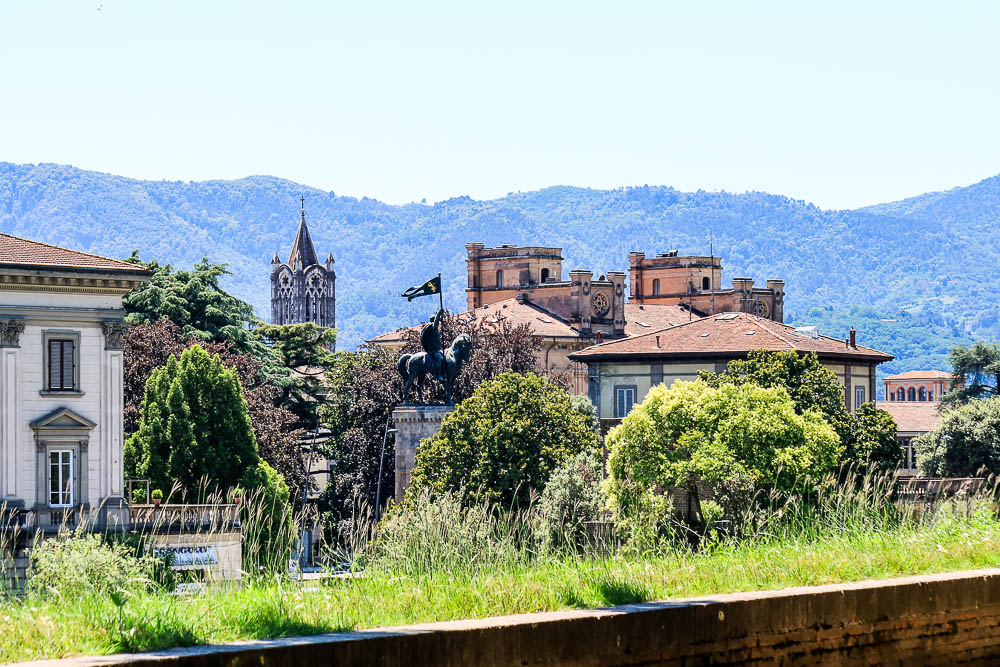
The most significant feature of Lucca is the walls surrounding the old city. Built for defense during the Renascence (although, apparently, they never served in battle), today they are preserved in their entirety, a rarity. Most impressive for me are the vast swaths of grassy fields around the walls (the former moat?). The walls themselves are brick, surmounted by massive trees. Approaching the walls from the hot and noisy modern part of the city, the old town appears as an oasis of green.


Even outside the walls, there are some magnificent homes in Lucca...


On this trip we stayed at the same Airbnb as on our last visit. Our hostess was very glad to see us again, and we were pleased to reconnect with her. While her rooms are a bit out from the center (a 10-minute walk?), there is space for parking a car. Added bonus: we could leave the car there while we were in Florence.


We passed these every day on our walk to the city.

The main purpose of our trip was to visit Florence before the crowds arrived. That worked well, but it was still a relief to get back to low-key, compact Lucca. We spent several long, tranquil evenings wandering the quiet streets as the sky slowly darkened. Sunday was our last full day in Lucca, and our hostess suggested we might want to drive up into the surrounding hills and visit some of the quaint villages; we studied the map and laid out a plan. But, it was not to be!


Detail of the gate from one house. Note the Tuscan shutters--they hinge up to let in light and air while keeping out the intense direct sun.


We left our parking spot Sunday morning anticipating a visit to a much-less traveled part of Tuscany. The route out of the parking lot was a tortuous path around several buildings (pretty standard, in Europe), ending with a security gate blocking off the main road. Not terribly difficult, but at the end, we could not get the electric gate to open! It was just a long plastic pipe across the exit, but the key fob we’d been given simply did not work. We finally accepted that today was not the day for us to be out driving.


Except… getting the car back to its parking space required backing down that long and tortuous path. At least the car was equipped with bumper sensors all around, and an advanced back-up camera that somehow gave an image of the car seen from above. I slowly reversed down the steep slope, and… oh, mercy! Found I could turn around. Ah, that made it easier! 


And thus ended our Tuscan driving adventure.


Approaching the city walls. Paula--mask in hand--heads for one the smaller, human-sized entrances. 

Through the tunnel under the wall and into the city!

Once inside we are greeted by one of Lucca's many towers.

The walls at night.


Instead of driving we spent the day strolling on the top of the city walls, some 4km (2.4 miles) all around. They’re wide enough for a two-lane road, but thankfully, are only open to pedestrians—and bicycles. We stopped for lunch at a restaurant owned by a couple who had stayed with us some years ago, back when our spare bedroom was an Airbnb guest room. It was good to connect up with them again; we were glad they were still in business, since the COVID lockdown was quite hard on everybody. (We figure part of our responsibility as travelers is to pump a little money into the local economy, which we were happy to do!)


The beautiful shaded road atop the wall.

Looking north across the city to the distant hills.

Looking south into the new town... and the distant hills.

Not much more to say about Lucca, really. It was very pretty, quiet, low key, and we had a great gin and tonic at a bar our last evening there!


Narrow curving streets provide deep shade on even the hottest days.


A quiet square in the old town.

Chiesa di San Michele in Foro, St. Michael's church on the site of the ancient roman Forum (the in Foro part of the name), with its funky statue of St Michael.


The bell tower of Chiesa di San Michele, seen down a narrow street.

Lucca's duomo, or cathdral, the Duomo di San Martino


A Saturday night happy hour crowd, social but not distancing! (Note the "Cafe Puccini" on the right: Giacomo Puccini, the opera composer, was born in Lucca!) 

The magnificent mosaic facade of the Basilica di San Fediano


One end of the huge Piazza dell'Anfiteatro, an oval "square" on the site of the former Roman amphitheater.

An entrance to the Piazza dell'Anfiteatro.

And finally, Torre Guinigi at night, a medieval tower topped with an oak tree.


 UP NEXT: The drive back. We didn’t go straight home; instead, we spent the night near the lavender fields of Provence and did a bit of exploring before getting on the road to Montpellier.