Wednesday, March 15, 2023

Special Edition: Seville for the First Time


I have a friend who will soon be fulfilling a life-long dream of visiting Europe with his family. So we're setting aside, for the moment, our own travels. This Special Edition blog is presented as a letter to Glenn and his family, with some tips on Seville!


Dear Glenn—

Welcome to Seville! I’m so pleased you can be here and experience this elegant, amazing city. To better appreciate it—or maybe, to faster appreciate it—I’d like to give you some tips.

         The first is a bit of history.

The story of early Spain, and particularly of Andalusia, southern Spain, is the story of the Moors. The Moors came from Northern African, from what is today Morocco and Algeria. They were Arabs and Berber and several other cultures, but they were all followers of Mohammad. They arrived on the Iberian Peninsula in 711AD, displacing the Visigoths. There was, of course, a lot of back and forth, but the Moors dominated in this region, which they called al‑Andalus, from which we get today’s Andalusia. Over a period of several hundred years the Christian Europeans slowly pushed them out, in what was called the Reconquista. In 1288 King Ferdinando III drove them from Seville. (The last Muslims in Spain were defeated by Ferdinand and Isabella in 1492.)

Interior of the Alcazar: Pool of the Maidens

The Moors left behind many buildings including mosques, tile works (apparently the banks of the Guadalquivir River are good for making tile and brick, and have been used for that for… well, forever), and their distinctive, geometric  art. The Christian and Islamic styles combined in Seville in a form known as Mudajar. A prime example of that style is the Real Alcazar (Real meaning Royal), built by Pedro I after the departure of the Moors. Another, more modern building is the Museo de Artes y Costumbres, the Museum of Popular Arts and Traditions, at the southern end of the Maria Louisa Park. But elements of the style can be seen in many buildings throughout Seville.

A view od the Museo de Artes y Costumbre.

A detail of the front of the Museo.
 

(And what are those traditional elements? Stone, brick, tile, wood, and iron. Look for them in the buildings around town. And while you’re looking, note the pointed arches and the distinctive Moorish doorways) 


One of our (many) favorites, an apartment building.
See the stone, brick, tile, wood, and iron?


Another striking building, a commercial building near the cathedral.


Churches! So many churches! Every neighborhood in the central part of town has a church. While it’s true that the Catholic Church dominated life in medieval Europe, there’s another reason for the plethora of churches here in Seville. Once the Moors where driven out the Christians were quick to eradicate the traces of Islam, which included converting every mosque into a church. (And in many, the conversion is obvious: look for the blocky, square tower that was the minaret, now transformed to a belfry.)


Once a minaret, now a bell tower!

While the façade has been altered, there's no hiding the former minaret.

So why so many mosques? In the Islamic religion, the faithful pray five times a day, and are called to prayer from the minaret by a muezzin. Because the faithful must be able to hear the muezzin, the mosques can’t be too far apart. So, one in every neighborhood.
        And, so, now one church in every neighborhood. (Spain becomes ever more secular; church-going is becoming less popular. And sadly, many of these neighborhood churches are in danger of being shut down.)
And another former mosque, now a Catholic church.


Now, another historic fact that makes Seville special: back in the day the Guadalquivir River was navigable, and Seville was a major seaport. (Being inland, it avoided the very significant problem of pirates.) It was such a major seaport that all the treasure ships returning from the New World with gold, silver, and tobacco unloaded here, before having their treasures transported overland to Madrid (then as now the capitol of Spain). This role brought enormous wealth to the city, a wealth that can still be seen in the elaborate palaces, and in the elegance of its everyday buildings.


         Food

A favorite subject of mine! Traditionally in Spain (I’m told, I haven’t really travelled much elsewhere in Spain) bars would give out little snacks with each drink. These snacks, called tapas, were typically something like a slice of bread with cheese, or tomatoes, or ham (of course!).


(The story is, one day the king was riding and stopped to rest and have a snack. The wind blew dust in his wine; his courtiers were quick to cover the goblet with what came to hand, bread. The bread that topped the goblet became known as a tapa; the name spread to include any small snack.) 

So a tapa is a snack, generally eaten with wine or beer. Then, so I’ve been told, during the economic downturn of 2008—which hit Spain hard—many of the traditional bars went out of business. Investors from Madrid came to Seville and hired top chefs to create gastronomic tapas, kicking off a competition for best of the year. Not every bar participated, but it certainly raised the, er, bar for a higher quality of tapas in Seville. (During a recent trip to Granada we found that bars serve a free tapa with each drink. Generally these are decent, satisfying snacks, although there may not be much choice—take what they’ve got, or not!) 

We’ve found that in Seville two of us can order three tapas and two drinks and have a very fine lunch for around €20. And while of course every place has their specialty, and some are better than others, pretty much any bar will serve a decent tapa.

         Notice that I am refraining from specific recommendations. There are many fine restaurants, of which I know only a few. And restaurants come and go. But there are a couple of areas where I know I’ll always find something I like. One is Plaza Alfalfa; another is Alameda de Hércules. They are both interesting places to explore, with numerous restaurants. If nothing else, you’ll see a good part of the city on your way there!


France holds to some pretty rigid eating hours: noon to 2PM is a semi-scared time for lunch, with offices and shops closed, and oftentimes it’s hard to get anything done then. But if you’re not sitting down to lunch at a restaurant by 1:30, you may not find a meal until the dinner serving at 7PM. (It’s happened to us!)


In Seville, though… don’t even try to find lunch before 2, when things are just getting started. By 3 restaurants are in full swing, and calm down around 5. Dinner is generally served at 10PM.

Yeah, but you can find filling tapas at pretty much any time!


Ham. OMG, there’s ham everywhere! And by ham I mean prepared, aged pig legs. You see them all over the place, hanging in every café, bar, and restaurant. Available in every supermarket. And, I expect, in almost every home.


Hams for sale on display. Similar displays are seen in every supermarket, and many bars.

These pig legs—hams—don’t come from just any pigs. There are various grades. The best come from 100% pure bred pigs that have spent their lives rooting up and eating acorns in the cork oak forests between Portugal and Spain. 

Lesser grades spend only a few weeks in the forests. Further down the quality slope are pigs that live in barns but get to eat a few acorns. And they’re not pure bred. But apparently, the acorn part is important, as it imparts a particular taste to the meat. After aging, the leg, er, ham is placed in a special holder and expertly carved with a razor-sharp knife into paper-thin strips about the size of a tablespoon. Quite a delicacy!


Ham ready for cutting into the thin slices so appreciated by aficionados.

Why this obsession with ham? Well, I figure it comes from the days when Ferdinand and Isabella were “cleansing” the county of non-Catholics. Jews and Muslims were allowed to leave, then asked to leave, then forced to leave. Or killed. Now, both these religions have strict prohibitions against the eating of pork, so apparently REAL Spanish—Catholics all—ate pig meat, proof that they were loyal. No one is checking religion today, of course (although there still aren’t many Jews or Muslims in Spain), but eating this particular delicacy is firmly established in the culture. 


Beer. Every region in Spain has its own. There’s Estrella Galicia, from the north-west, and Alhambra, from around the city of Granada. But my favorite is the local Cruzcampo. Nothing finer than taking a seat at a local café after a long walk through the crowded city, ordering a caña, and feeling that cold, cold brew bubble down my throat! The glasses are small and tend to be inexpensive. Depending, though, on where: outside the center things are simple and generally inexpensive, but at the foot of the Giralda, in the main tourist areas, it’s fancier and pricier. Of course! 


There’s more, of course. Much more! But there are guidebooks, and free walking tours of Seville (and many other major cities), and Rick Steve’s audio-guided walking tours (download them for free from his web site—check out his videos, too!)..And then it comes down to your own explorations. 

So get out and start walking!


Tuesday, March 7, 2023

Back in France


The iconic Morro Rock and Morro Bay seen from the Elfin Forest, a few minutes walk from our house.


It’s snowing today. Yup. Snow. What the heck?! I mean, we're back in Montpellier. This is the South of France, for crying out loud!

And to think we left sunny warm California for this:

My thoughts Monday morning when I woke up to snow!


What we left: the view from our downstairs apartment in California.


 It’s been four or five days since we’ve been back. We’ve recovered from the jet lag… mostly. Still waking up at 5AM, but that happens anyway. 

The trip back was good. We fly on frequent-flyer miles, and so take what route we can get; not always the most direct! This time we flew from San Francisco to Lisbon, Portugal. (Our one requirement is that we get a non-stop from the west coast to Europe: no stops in O’Hare, or JFK, or Newark, especially in the winter!) We had one more flight, this one to Barcelona; our third counting the commuter hop from San Luis Obispo, “our” airport, to SF. 

Thankfully, we had a chance to rest, spending the night in Barcelona. We had a good night's sleep in a quiet hotel near the train station. The train is comfortable, far less stress than a plane flight, and by 2PM the next day (Wednesday) we were making the short walk from the Gare Saint-Roch to our apartment in Montpellier.


Yeah, so if the video doesn't work, this is what I was looking at! That's snow on those cars, seen outside the window of our apartment in France.

Now, about that snow… It seems it snows here about once a decade. We’ve seen photos—old photos—of snow on the ground. This stuff falling now probably won’t stick. Ah, and it was so sunny and warm yesterday! A sunny Sunday, followed by a gloomy Monday.

(No, it did not stick. The flurries stopped after about an hour, and the temperature only seemed like it was freezing and in a few hours the accumulation on the car roofs was gone.) 

We are slowly getting back into our French way of life, although the rainy weather, aided by the jet lag, has put a damper on our excursions out and about. Our friends Mark & Mary did invite us over for coffee, along with some of our other friends here. It was a nice “welcome back”! 

And we are glad to be back, although the pleasures of California—the climate, the gorgeous landscapes, and of course our many friendships—still resonate strongly. It was a reminder that much as we enjoy life in France, we still feel very connected to our California home. 

It was also a chance to renew our acquaintance with the physical beauty of life on the California coast. We are nowhere near done yet with our time in France, but it would not be a tragedy to return to California!

 And since we're speaking of the physical beauty of the California coast, here's a few images...


We introduced our friend Frank to the wonders of the Elfin Forest in Los Osos. This is his photo, with Hollister Peak in the background.

Frank in the boardwalk.

Frank's photo of the elf he found in the Elfin Forest.


 While visiting the near-by community of Morro Bay we found this otter mother caring for her new-born in a protected corner, oblivious to the human passers-by.

Mama otter, in the protection of the commercial docks in Morro Bay.
 

Reaching for her new born, which she stashed against the rocks while she had a snack or two.


Mama and baby.


After all the rain, this will be a booming (blooming?) year for wild flowers; sadly, we will not be there to see them! But we got a preview at Montana de Oro, our local State park, where the California poppies (the State flower!) are popping out.

Paula got this picture of California poppies in Montaña d Oro with her new iPhone 14.


Paula in the poppy fields.

Cliffs at Montaña d Oro


Up next: We have ambitious travel plans for spring. Mid-March we meet our friends Sue and Alan from Portland OR in Paris. From there we'll all head to Petra, Jordan and the exquisitely carved caves there. After that we will, finally, complete the trip to Sicily we planned pre-Covid, then Napoli and Sorrento and end with a few days in Rome. There are sure to be some good tales coming from that trip!


        But for now, we'll say


            Ma’a salama


            Arrivederci


            À plus tard


            See y'all later!


Hollister Peak, seen from the Elfin Forest near our house.


Thursday, January 26, 2023

California. Be Here, Now.


Our end of the long valley with volcanic peaks... and green!

Well, we made it back! Back to our cozy pied-à-terre in Los Osos. And we’re glad to be here! The flight over was long and boring; nothing happened, just the way we like it. It was also disconcerting and disorienting. We fly Business Class, but even with the extra room, the personalized (slightly) service, the wide, lie-flat seats, it’s still spending 12 hours in a narrow metal tube seven miles above the earth’s surface. (In addition to getting up at 4AM to make the connecting flight, plus all the usual interminable waiting in lines at the airports…) Disconcerting, indeed! 

But we survived, and landed in San Francisco during a lull in the widely-publicized series of storms that have been hitting California. We rented a car and drove south through the slow Bay Area traffic. We stopped in Gilroy for the night, a good thing as we were both wiped out.

Up early the next day (as if we had a choice through our jet lag!), we were on the road before dawn, driving past gorgeous green hills. All down the Salinas valley, and from King City to San Luis Obispo, the countryside was impossibly green. In most years it’s spring before these hills green up, where they have but a month or two before the hot, dry summer. But on this trip, all the way south we passed gorgeous, green pastoral-looking countryside!

Pastoral countryside, what much of California looks like.

The flooding was long past, but there were ample signs of it: mud and sand on the road, small lakes in the middle of fields. The Salinas River was well behaved by the time we arrived, but the wide river bed was a jumble of mud and bedraggled trees and bushes.

Ah, California! Dead-looking oaks against the green green hills.


We managed to miss the rain, mostly—we arrived at the bottom of the Cuesta Pass, just minutes from the city of San Luis Obispo, when the first drops fell. And then, how they fell! Heavy, heavy rain. But we were in familiar territory now. We made our slow way to the airport to drop off the rental car, where we were met by our friends from Oregon, Sue and Alan.

Driving through San Luis to our house in Los Osos, Sue gave us a running commentary on what had been happening over the last few days of the storm. As we drove along our once-customary streets, past familiar houses and yard, both Paula and I had this strange sensation of never having left: it was like we were gone on an overnight, and it had rained. A strange sense of odd familiarity, a bizarre case of déjà-vu. 

We’re sure glad to be back, though! It has actually been 18 months since we were last here. The house and property are fine; we live on what is essentially a sand dune. It’s well elevated, and the drainage is great, so no water issues at all. Actually, while there was some flooding and damage in our small town, it was very localized and had been cleaned up by the time we arrived.

But enough of me! Paula has some observations as well:


Well we’ve been back 2 weeks—it went by fast: lots of rain, flooding and mudslides (not at our house), adjusting to CA time, seeing friends, getting used to a new iPhone (me) and camera (Paul). France seems far away. Thankfully, Be Here Now is a real thing. And soon we’ll be back in France, and it is California that will seem far away.

So I thought it was a good moment to send a few photos and thoughts of life here – both our little pied-à-terre and the area.

First some general impressions:

  • Kale is out, chickpeas are in. California is the land of healthy fad food. Last time we were here 1-½ years ago it was kale EVERYTHING. It’s now been replaced by chickpeas. I love garbanzo beans so I’m happy. Oh yes KETO is the rage too. Thankfully I love carbs.
  • Trader Joe’s still kicks butt with new food recipes to try. Many are delicious – like stuffed gnocchi with mozzarella and tomato sauce. Or sweet cannoli dip. Or an old favorite, chicken sausage. And I’ve been having a great time making fish tacos with the BEST corn tortillas. And enjoying great Mexican and Thai food. There is a new bakery here that makes delicious croissants and pain au chocolat - heaven.
  • This is the season of green – in CA it only rains until April and we live at the end of a long valley of volcanic peaks and GREEN in every shade. They are even called the Irish hills – but only until May. Then it’s all brown. We live 5 minutes walk from a huge estuary and ocean and land that will never be built on. It is glorious.
The back bay at low tide, with the famous Morro Rock in the distance.
Five minutes from our house!


  • Our downstairs apartment is very familiar and cozy. And has lots of kitchen stuff and sharp knives. And “our own bed”. Wow. Decorated with mementos of France and Spain, of course. If you are ever in Central Coast California - let us know. It's usually vacant.
Our living area.

Our own bed!


  • After not driving for 1-½ years I am happy to report it is like I never stopped driving.  Even with manual 5 speed. But the cars and trucks seem bigger than ever. Scary.
  • Because we don’t have street lights in our little town—heck, some streets are still dirt—we see the stars – bright and shiny – I had forgotten how glorious that is!
View of the fairy land that is our night time garden. Yes, there is a star up there!


  • And lastly I thought it was quite serendipitous that one of my favorite watercolor painters was offering a 4 week class right in the middle of my time here.  Can't get better than that.

It might seem like I am falling in love with my old home again. I am, but I think it’s a passing affair. We are flirting. I’ll be ready to head back to France and Europe—it’s still my first love.

Daytime view of the garden.
Miss you all and hope you are enjoying life wherever you may be or traveling to.


And, facing away from the bay, we have this view!

We’ll be here in California until late February. Then it’s back to Montpellier! And hopefully, winter’s end. Until then, we’ll see what we can get up to here in Los Osos.


Bishop's Peak (right), the most prominent of the seven volcanic peaks;
 at the opposite end of "our" valley.


Wednesday, January 11, 2023

Seville, 2022

                      11 December 2022
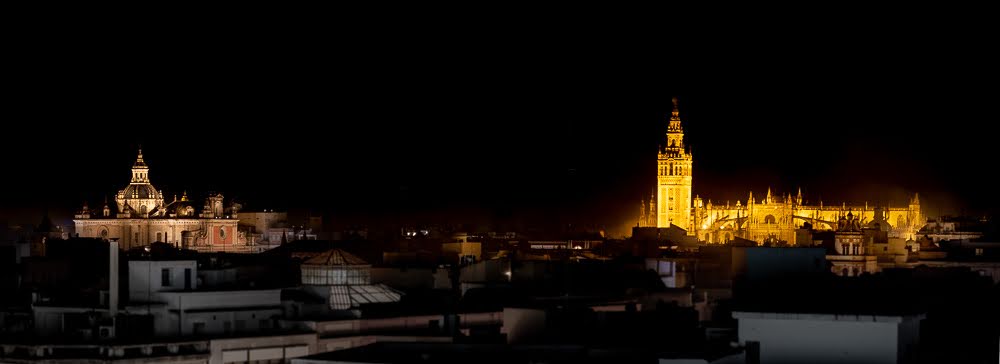
A distant view of the cathedral and La Giralda, with the 
Inglesia Colegial del Divino Salvador (Collegiate Church of the Divine Savior) off to the left.

Well. We finally arrived! We made our first foray into the city at night, checking out the Christmas lights, spotting the well-lit Giralda and Cathedral; and stopping, finally, for our first caña (small draft beer) in Seville. I feel like we are finally really here!

Christmas lights with La Giralda .


And, it’s warm! When we left the temperatures in Montpelier, in the sunny south of France, were in the low 40s; here in Seville it’s in the high 60s. Wonderful! We’re so pleased.

 On the other hand, it is raining. And raining. And raining. But it’s warm! Apparently it’s been raining a lot. As the plane landed we saw flooded fields surrounding the airport. Walking to our new-to-us apartment we crossed streets that were partially flooded. But it’s warm!

Every time we come to Seville—and I think this is our fifth time—we stay in the same place, a cozy little apartment located in the old Jewish area called Barrio Santa Cruz. But this time we chose to stay somewhere else, just for a change. Just for central heating! We want to get away from those individual room heaters. Now we’re in a modern 7-story brick building, surrounded by other modern brick buildings. Not visually inspiring but we’ve got a spacious apartment, lots of light, and a view of the sky. And central heating!

Two things we always seem to do while here in Seville is buy footwear (see this earlier blog about Spanish boots), and visit the dentist. Our first year here we had our teeth cleaned by a young woman from Peru just getting her dental practice started, and we’ve been going back ever since.

And, it just so happens that the new place where we’re staying is near the dentist. Like, a half-block near. With reservations made well in advance, we strolled over on the morning after our arrival and re-acquainted ourselves with Dr. Laura.

Our apartment building and.. a shoe repair shop!

After our cleanings Paula was musing about our other habit. Did she need new boots? Or maybe just get the old ones re-heeled… Then we turned the corner and there, right on the ground floor of our apartment building, was a shoe repair place! (And just in case I wasn't sure what reparacion de calzaos meant, there was a picture of a shoe--and a key, because also available was duplicados de llaves).

We stepped into the shop, crowded with other customers. There was a large fellow in a white smock standing in front of a complex looking machine with grinding wheels and buffers. Paula asked, using pantomime and her best pidgin Spanish, How much to get these heels fixed? Next thing we knew Paula was offered a chair and the cobbler was slicing, cutting, grinding, gluing, and trimming. Ten minutes later her boots were good as new! 

The large fellow slicing, cutting, grinding, gluing, and trimming.

As we were paying (€10! about $11USD) I noticed a woman—the cobbler‘s wife?—at an industrial sewing machine fixing a strap on a ladies purse. It was big smiles all around, and we really wished we had more broken things to get fixed.

Twenty-five steps later we were standing in front of our sixth floor apartment door, marveling at what had just happened. Fastest case of “you want it, you got it” I’ve ever seen!

Well, after that first week the rain stopped, and we’ve been enjoying the magnificent weather. Our new lodgings are a bit further from the center, but make it easier to get to some areas we’ve rarely visited (too far then, plenty close now, from our new location!)


                 Christmas Lights

Every year we rush to the Plaza de San Francisco, one of the major squares downtown, to see what’s installed. One year it was an ice skating rink, one year three giant angels in lights, one year huge crowns. And this year…


Animation!

Animated light displays! Colors and images flowing across the surface of these giant hemispheres.


Colors! Note the figures on top...

The girouette (weather vane) on top of La Giralda; copies are mounted on the light domes.


Plus all the usual lights strung across the boulevards. 


Crowns along Calle Sierpes


Lights and the exquisite buildings along Av. de la Constitución.

The ever-popular Plaza del Salvador.


Oh my, but how time flies! This was written just when we arrived, and now we’re all packed up and ready to go back to the States—tomorrow it’s up early and on the plane. Once we’re in California maybe we can catch up on what we’ve missed…